

🇺🇸 Start
Tomorrow's the Fourth of July. The 250th one.
I've been thinking about independence. Not the fireworks kind. The operational kind. Who can see which knowledge. Where it came from. What the system remembers. What it's allowed to do. Which application puts the answer in front of the person doing the work.
If you run a company, those questions are your AI strategy. The model isn't.
Frontier models are extraordinary, and they keep getting better. The companies building them deserve the credit they get. But renting intelligence isn't the same as owning your operation. The companies getting durable value from AI are the ones that stay independent where it counts: their knowledge, their permissions, their audit trail, their applications.
This week Alex Karp made a version of this argument on CNBC. Palantir plays at a different scale and serves a different market than we do. The principle travels anyway. It's worth four minutes of your holiday weekend.
🧭 Going Deeper
The AI conversation keeps drifting back to the model. Which one's best. Which is cheapest. Which has the biggest context window.
Fair questions. None of them is the implementation problem.
Inside a real organization, the hard questions sound different. Which sources are trusted for this task? Who's allowed to use them? What should the system remember, and what should it forget? Which model answered, and what shaped the answer? What gets logged? Where does a human review the output? Which application does your analyst, your operator, your customer actually see?
That set of questions is the control layer. It governs knowledge, memory, roles, access, prompt policy, model routing, and audit. It isn't the glamorous part of the stack. It's the difference between a demo and an operating system for work.
🧠 The Obsession That Became a Platform
In 2024, I became obsessed with RAG-based AI chat. That's the word. Obsessed.
I'd been experimenting with chat applications for years. Then ChatGPT plus RAG opened my mind to the future, and it's happened fast.
The goal seemed obvious. Take a knowledge base, connect it to a model, make the model answer from the material, and give people something better than search.
Useful. Not enough.
The moment we started deploying real systems, the work changed. The chat interface was only the surface. Underneath it, clients needed source management, roles, access controls, prompt management, workspace boundaries, memory rules, audit trails, model routing, and application logic.
They didn't need a better chatbot. They needed a governed knowledge and application platform.
That's what Knowledge Spaces became.
🗽 Presented by Knowledge Spaces
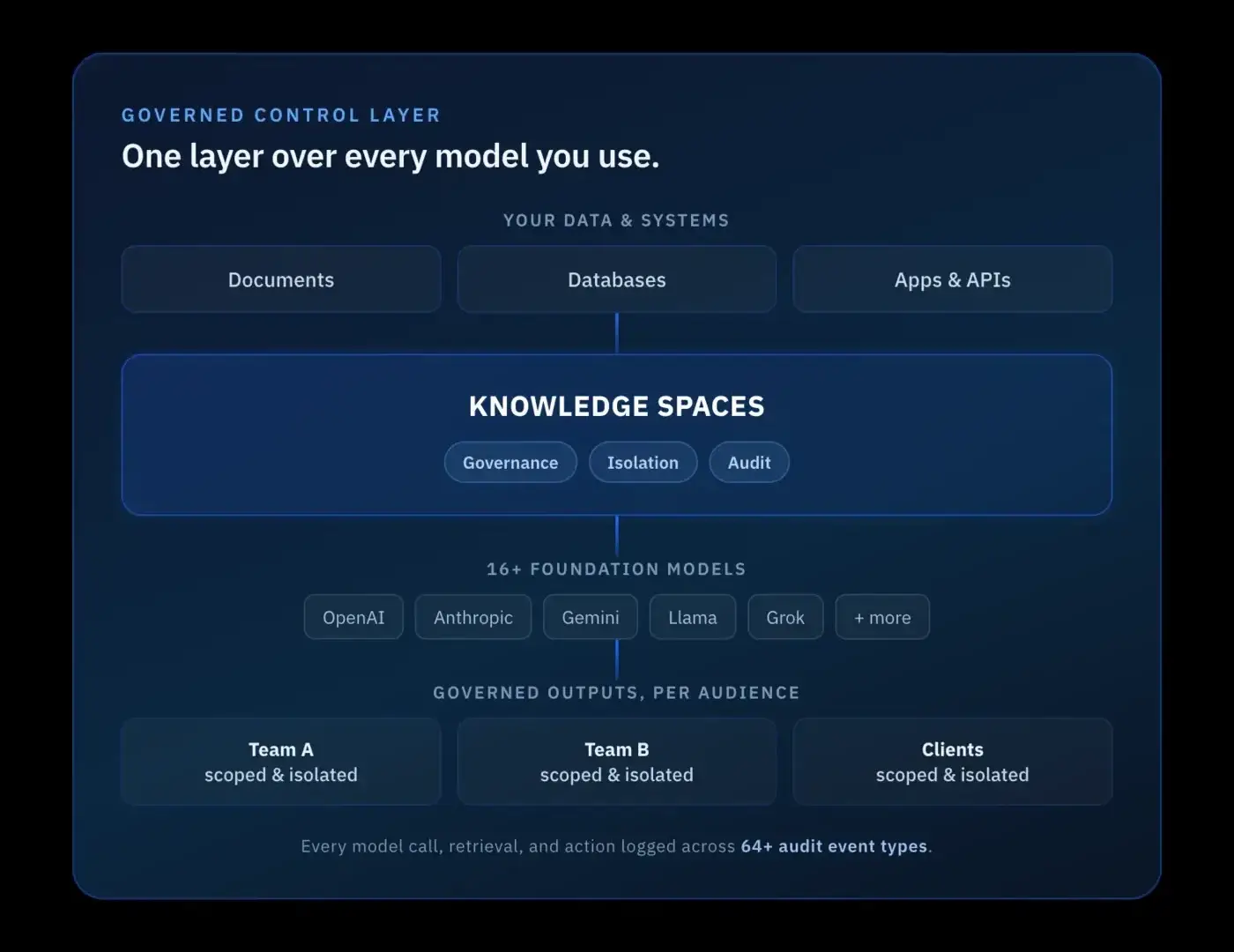
Knowledge Spaces is Sprinklenet’s managed platform for governed AI. It sits between your knowledge, the model providers, and the applications your people use. Every answer is traceable. Every permission is enforced. How your business thinks stays yours.
⚙️ Application Layers Are Where Work Happens
Most end users will never see Knowledge Spaces. That's by design.
They see the application layer: the analyst workbench, the internal assistant, the customer-facing experience, the claims desk, the compliance console, the research interface, the operational dashboard.
That's where AI becomes work. A model can generate text. A governed application helps a team finish a task, follow a process, make a decision, and keep a record of why.
The next wave of useful AI software won't be one chat box sitting on top of every company. It'll be specific applications, each connected to the right knowledge, the right permissions, and the right human review points. The control layer makes that possible. The application layer makes it visible.
🏢 From the Office

This week, Manuel and Nela were in the office working through how we train and support other builders on the Knowledge Spaces architecture.
That work matters to me. Sprinklenet shouldn't be the only team building on this foundation. Systems integrators and AI developers should be shipping their own application layers, dashboards, and workflow tools on top of it.
The future belongs to builders. Not isolated ones. Builders who combine strengths: domain experts who understand the work, product people who understand the user, engineers who turn repeatable judgment into software, and a governed platform that makes all of it usable inside a real organization.
🛠️ Build on the Control Layer
We're preparing programmatic access to Knowledge Spaces for developers.
Bring the workflow, the domain, the user experience, the customer problem. Knowledge Spaces handles what sits underneath: structured knowledge, routing, permissions, managed context, and the connection between your material and model behavior.
We already see it working. Partners are building their own application layers on the architecture with us. Their methodology stays theirs. Their market stays theirs. The governed platform underneath is what we bring.
If you're building a serious AI application and need a governed knowledge layer under it, reach out. Or reply to this edition and tell me what you're building.

I'm back in building mode. Growth mode too.
Some news on that front. Sprinklenet just signed a three-year license agreement with a major partner that's rolling Knowledge Spaces out globally across its business. I've been in their corner for a long time, and this deal takes the partnership to a new level. They're preparing a substantial venture round, I'm deep in that work with them, and this is just getting started. I'll share more soon.
There's a moment in a company when the architecture stops being internal conviction and starts being something other people build on. Knowledge Spaces is at that moment now.
The models will keep improving. Good. I use them constantly. But the companies that win the next decade will be the ones that know how their knowledge, people, permissions, memory, and applications fit together, and keep control of the whole picture.
Two hundred and fifty years in, independence is still the best operating principle I know.
Happy Fourth. Enjoy the fireworks.
Jamie
🎧 Weekly Spotify Mix
This week it's “We Built This City” by Starship.
Literal this time. That's the energy going into the weekend.
🎧 The player below works in the web edition. Reading this in email? Listen on Spotify.

