

This Week We Ship ⤵️
Good morning and happy Wednesday. It's July 8th and while many people are in vacation mode, we’re doggedly focused on shipping product because things are moving at breakneck speed in AI.
Today I’m happy to announce version 1.0 of our Knowledge Spaces Developer Program, geared toward small and mid-size enterprises that want to grow their businesses in the age of AI, but recognize they need to maintain control over their own knowledge, data and products.
It Was Never About Your Data 🔒
I want to begin by saying that Sprinklenet's business model has nothing to do with training on other people's data or knowledge. If you look at the major frontier LLMs, a lot of the game is about acquiring more data. Your data. We all know this.
Yet it's so alluring to want to give them everything and let them work magic. Still, I believe there is a need for middleware, a control and governance layer, like Knowledge Spaces.

Who Am I to Doubt Karp 🧭
Alex Karp referred to Palantir's version of Knowledge Spaces as an application layer; that's what he called Ontology last week on CNBC. Some of you may have seen that interview and others may have heard about it from my edition last week.
Who am I to doubt Karp, but I sort of look at the naming a bit differently.
I see Knowledge Spaces as the control layer between your models, your governed knowledge, and the applications your employees and customers actually touch.
To me, the application layer is the layer at the very top.
We build application layers for some clients because that's where the rubber meets the road on how their employees and clients ultimately interface with AI, whether it's through chatbots or intelligence dashboards or interactive websites.
Each of those application layers sits on top of Knowledge Spaces and is connected via APIs to the governance and configuration controls that Knowledge Spaces provides.
The APIs Are Open 🔑
Today we are releasing those APIs through our new Knowledge Spaces Developer Program.
We’ve been building against our own APIs internally for over a year. We've been studying the systems and architecture for a while: how to scale Knowledge Spaces across AI products, workflows, and client-facing software.
We started with tenant isolation and the detailed governance options needed by our regulated or semi-regulated clients, and we've added the ability to extend their use of Knowledge Spaces to their own clients.
We call this the Principal Organization approach. It’s available programmatically now.
Why I'm Renaming This Newsletter 🎛️
I’m excited to extend and offer the capabilities of Knowledge Spaces to you, my executive readers and supporters, so that you can grow your own client bases and customer uses cases of your knowledge, integrated with AI, but done in a way that keeps you firmly in control.
To that end, I'm updating the title of this newsletter to Hold the Controls because I think this is the way in which I can be of maximum service to you and your customers.
We're entering an age (err, we're now squarely in it) where knowledge management, while not front and center of what your clients and users see, needs to be baked into your AI-powered systems at an architectural level.
And managing and supporting such a layer is no small feat. I don't care how good the coding agents are, I use them all and it's still a ton of work and time.
The Patterns I Keep Seeing 🔭
That gets me to my next point. We've been testing the market response, building and stress testing Knowledge Spaces for over a year. And I see a few patterns (you know I like to point out patterns via this newsletter sometimes).
I see that many people (obviously) are coding up really cool new software applications and services using Claude Code, Codex, Vercel, Lovable, etc. and a myriad of other AI development tools. I see a lot of these new tools get into baseline production inside their respective companies, but they almost all stall out for a few reasons. One, maintaining them takes time, focus and money. Software doesn't just fully run itself. And two, you need smart humans with energy and focus to keep the trains running.
Energy and deep focus are the coin of the realm.
Yeah, we read about how Claude Code now writes its own code, but I can assure you, there's a highly capable engineering team that keeps the systems running and make plenty of decisions (the human decisions still matter). Maybe it's possible in the future we don't need humans, but for now, we still do.

The patterns follow me around.
So that means while it's relatively easy to code up some cool new proofs of concept, it still takes effort to refine them, run them and manage them.
I think it's more likely that we'll see companies go from needing mid-size teams of strong developers to small teams of senior developers with energy, focus and a deep understanding of the tools. A small, high-energy senior team will run circles around a large team of less focused, less motivated ones.
Large, unfocused developer teams are losing leverage fast. So yeah, the AGI prophecy is coming true, but at the moment and for the foreseeable future, there's no substitute for the top performing humans who know how software works and can fully articulate what needs to be done.
It's not just about being an expert at coding anymore, you need to be an expert with code and the English language, and clarity of communication with your stakeholders.
So What's Your Plan? 🤔
Ok so the other thing I'm seeing a lot of is companies that move beyond the initial proof of concept and they've managed to muscle their AI testing turned product into production. They make it work, but it gets exponentially harder when they need to replicate and scale it across thousands or tens of thousands of client experiences where you want to make each interaction truly custom and unique to the end customer.
That's what Anthropic, OpenAI, Google, Meta and a few others are doing. If you're not one of those top enterprises, then what's your plan? How are you really going to serve thousands, tens of thousands, potentially millions of your own customers with an AI product that is essentially still controlled by one of the big model companies?
Let Us Be Your Invisible Layer 🤝
Yeah, we're all looking at open source models. And as Alex Karp indicated, the open-weight models that can operate as components with Ontology and Knowledge Spaces are good solutions, but even that is a herculean effort at productizing, operationalizing, and maintaining at scale.
I'm not saying it can't be done, but it takes you away from focusing on the application layer and your specific value-add in the global marketplace. I want to help you. I want to partner with you. I want you to work with me, my team and Knowledge Spaces so we can be the invisible layer that guards your hard-earned knowledge, trust and future value.
If you're a Fortune 100 company you probably already use Ontology and have a fantastic relationship with Palantir.
If you're not a Fortune 100 company and you wish you had the budget and team to have access to the best in the world, like yesterday, well, reply to this email and tell me what you’re trying to build. I’ll tell you quickly whether Knowledge Spaces is a fit.
Developers, Developers, Developers 🔊
More than two decades ago Steve Ballmer bounded across a stage screaming one word until he lost his voice: developers. People laughed. He was also completely right. Every platform that won, won because it made builders powerful.
The AI era is the same story. It's not going to be won by the biggest model. It's going to be won by the builders, the people inside your company who can turn AI into something your customers actually feel. The knowledge workers who can leverage knowledge platforms.
My whole pitch is this: let us enable your builders.
Knowledge Spaces gives your developers the control layer, the APIs, and the governance to build fast without handing your data away.
You bring the builders. We hand them the controls.
Build on the Control Layer 🛠️
Oh, and lest I forget, if you're a developer or you want to pass this along to your trusted internal development team, here's the registration link to join the Knowledge Spaces Developer Program:

PS I one-shotted this direct from my brain to text editor at 4:30am, pre-coffee. But like all things that come from the brain and work their way into production, it's always days, weeks and years in the making.
Have a great day everyone. See you on the Internet.
Hold the controls.
Jamie
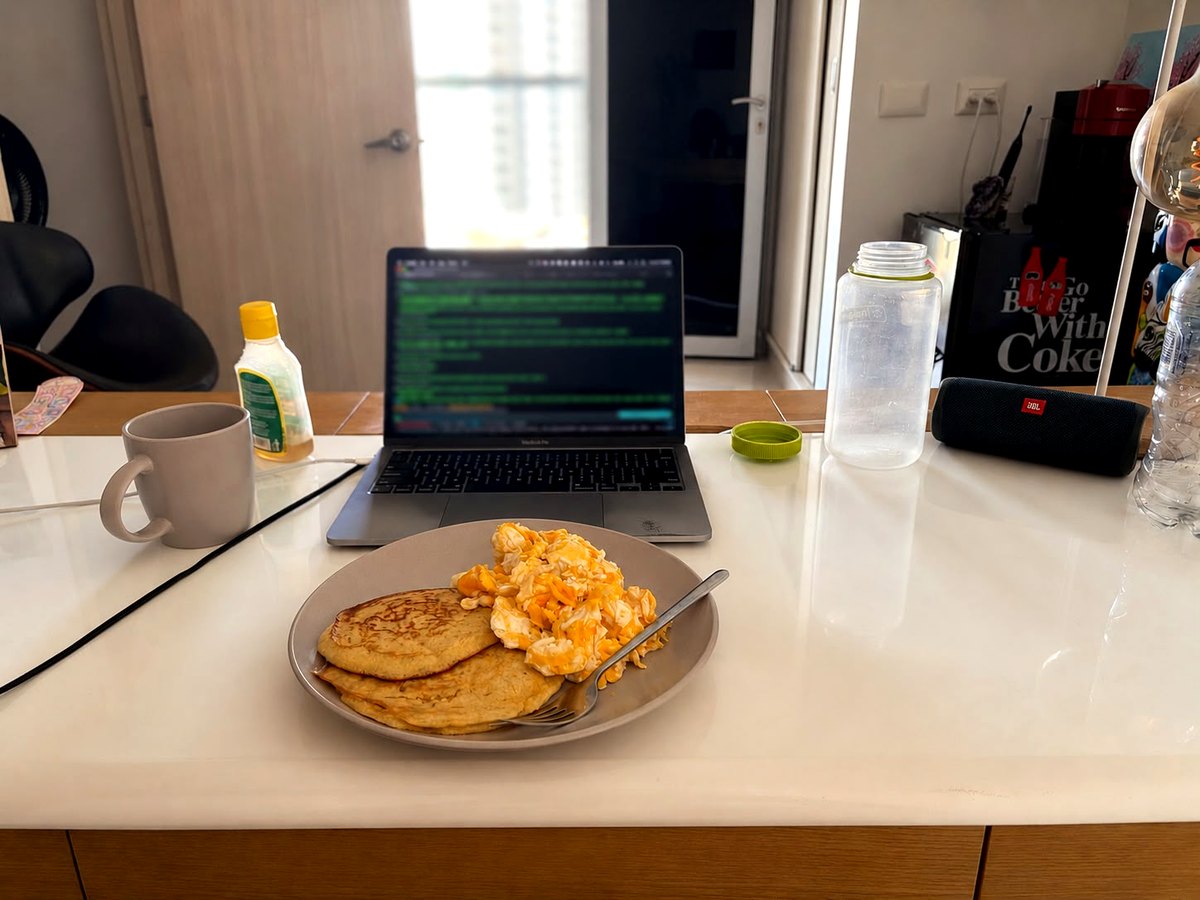
The APIs went out with breakfast.
Federal Roundup 🇺🇸

One more thing, for the federal buyers and primes on this list. Sprinklenet is a GSA Multiple Award Schedule contract holder, so AI strategy, custom AI engineering, and Knowledge Spaces delivery are all available through a vehicle your contracting officer can already use.
Jamie’s Weekly Spotify Mix
Well, it's now the second year in a row that we'll be hearing my Julio con Julio mix.
A year ago when I published the Julio mix, I knew where I was aiming, but I didn't know all the details, twists and turns that would appear along the way. I'm still here. I'm feeling strong, focused, grateful and excited. Enjoy my Julio Iglesias mix of some of my favorite songs.
🎧 The player works on the web edition. In email, use the link below.

